 Blog
Key Takeaways
- Most new pools built in the Valley are play pools with depths ranging from 3 to 5 feet.
- Deep diving pools require massive yard space and significantly higher heating costs.
- Standard Baja shelves require 9 to 15 inches of water depth for in-pool furniture.
- Modifying an existing deep pool into a shallower play pool is a common remodeling project.
- Heating a deep pool in an Arizona winter requires substantially more time and gas.
- Hard caliche soil in Phoenix makes deep excavations expensive and time-consuming.
Determining the right swimming pool depth in Phoenix AZ comes down to how you actually plan to use the water. Most homeowners assume they need a deep end. In reality, a pool with a maximum depth of five feet provides the best experience for lounging, playing sports, and socializing.
Water depth dictates water volume. Volume dictates how much gas you burn to heat the spa, how much liquid chlorine you buy in July, and how much space the pool consumes in your backyard.
A swimming pool is a permanent concrete vessel. Choosing the wrong depth during the design phase results in wasted water, wasted heat, and unused space that cannot be easily corrected after the shell is poured.
Sun America Pools & Spas has designed, built, and remodeled custom pools across Phoenix, Scottsdale, Paradise Valley, Chandler, Gilbert, and Mesa since 1985. Our owner-led design-build process ensures your pool dimensions match your lifestyle before the excavator ever reaches your property.
How Deep Should A Swimming Pool Be?
The answer depends entirely on the primary function of the pool. Modern pool engineering typically falls into three categories based on the slope of the floor and the activities intended for the space.
The Standard Play Pool
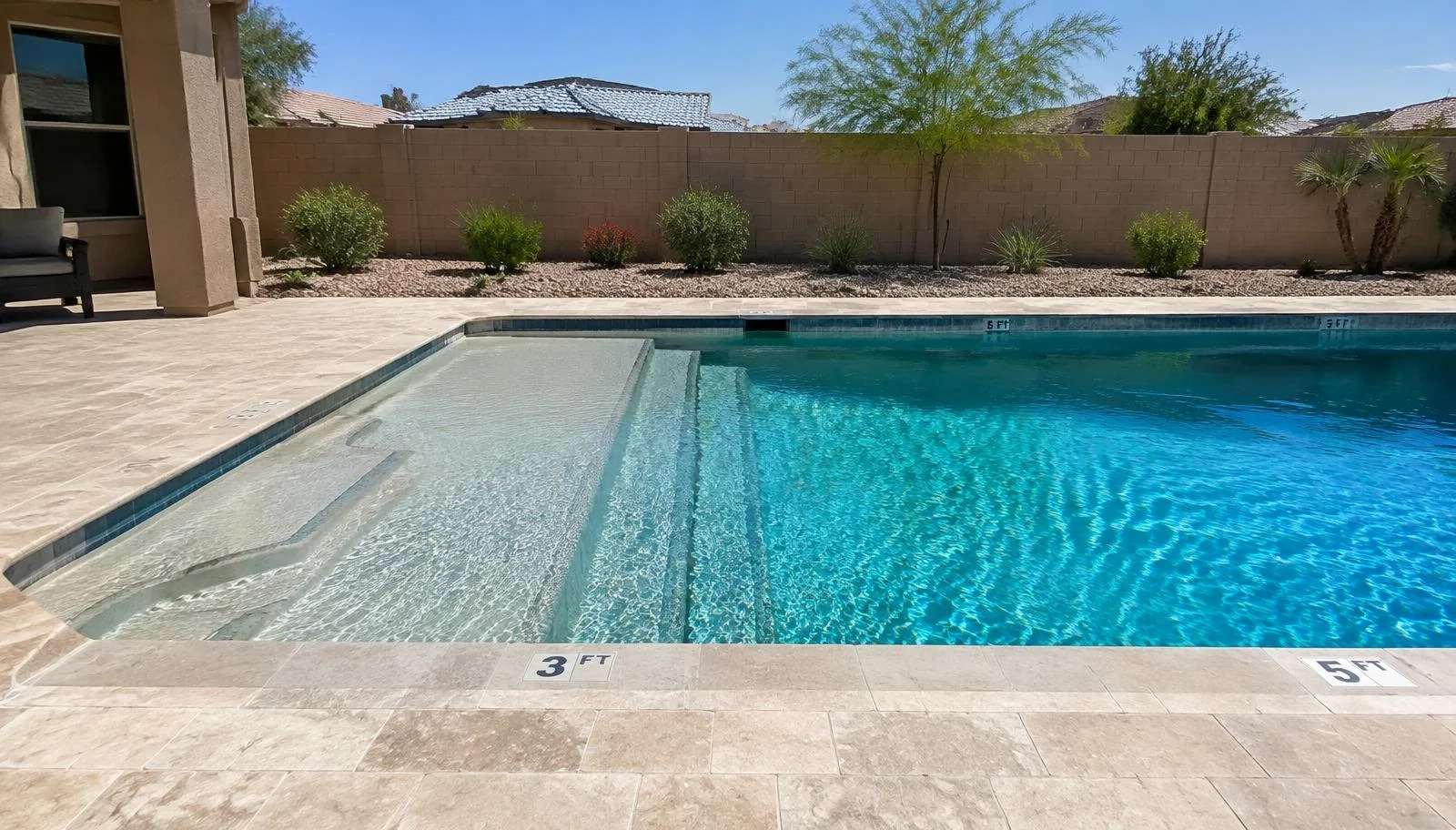
The play pool is the standard design for the vast majority of new builds in Arizona. The depth starts at 3 feet near the primary entry steps, slopes gently to 5 feet in the center, and slopes back up to 4 feet at the opposite wall. Builders often refer to this as a 3-5-4 configuration.
This depth profile is highly functional. Adults can stand comfortably anywhere in the pool with their heads above water. It allows for full-court pool volleyball or basketball. It provides enough depth to swim laps comfortably without wasting water volume.
The Traditional Diving Pool
To safely accommodate a diving board, a pool must reach a minimum depth of 8 feet. However, you cannot simply dig an 8-foot hole. Structural engineering and safety codes require a specific "diving envelope." This is the slope and distance required to transition from the shallow end to the 8-foot deep end safely.
Meeting this requirement usually dictates a pool length of at least 35 to 40 feet. With backyard sizes shrinking across new developments in Gilbert, Queen Creek, and North Phoenix, a diving pool often consumes the entire lot. You also sacrifice standing room. In a standard diving pool, only the first 10 to 12 feet of the pool is shallow enough for standing.
Flat Bottom Pools and Spools
Flat bottom pools maintain a single depth, usually 4 feet, across the entire structure. These are ideal for dedicated lap pools or water aerobics. Spools (spa-pool hybrids) also frequently use a flat bottom. Because spools are small, they are designed primarily for seating and soaking rather than swimming. A flat depth of 3.5 to 4 feet allows for comfortable bench seating around the entire perimeter.
Custom Pool Depth Options for Phoenix Backyards
A custom pool does not have to be a single empty basin. Modern designs incorporate various depth zones to accommodate different activities and furniture.
Baja Shelves and Tanning Ledges
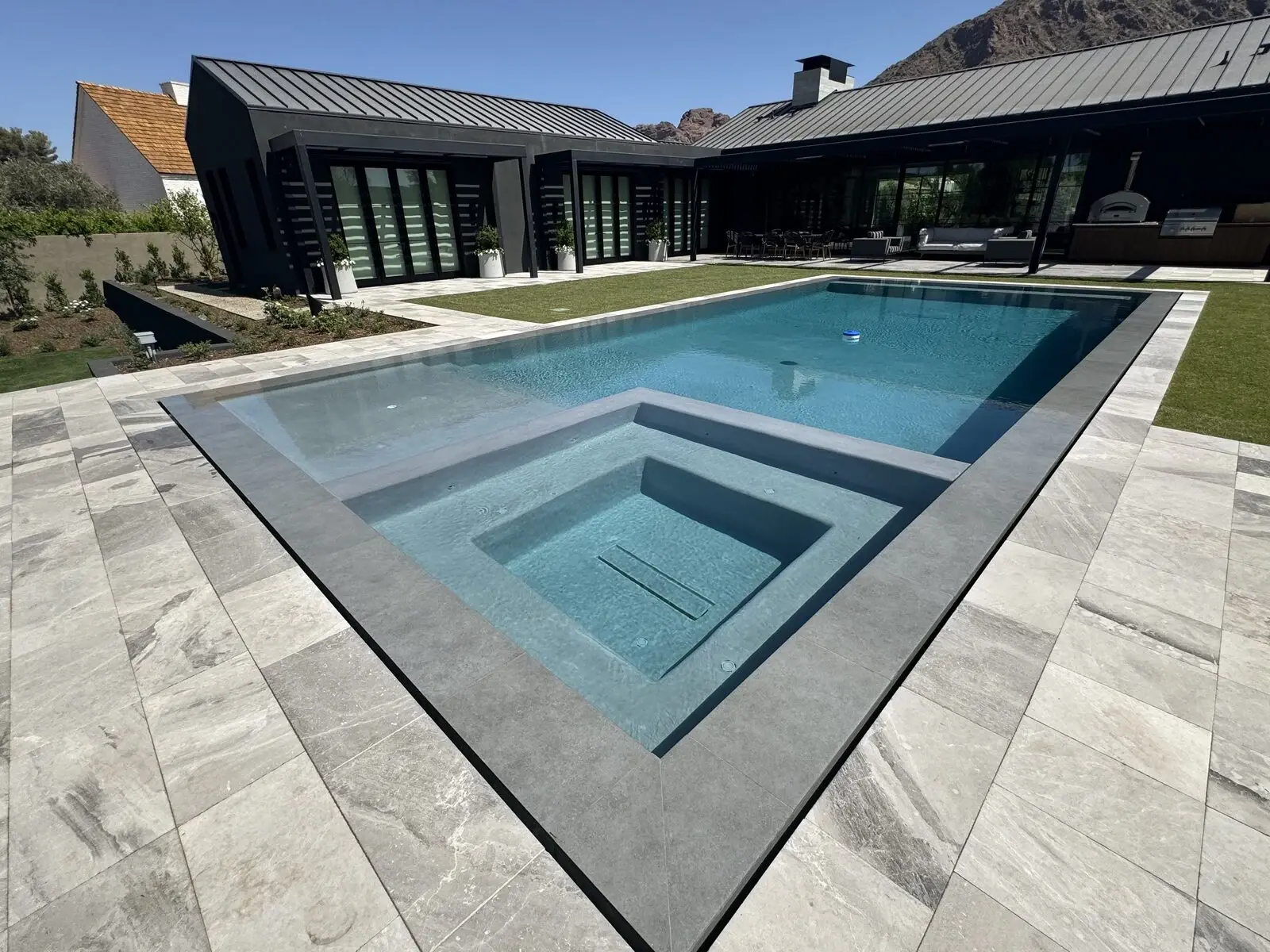
A Baja shelf is a large, flat ledge located at the entry of the pool. Homeowners use these areas for sunbathing in shallow water or providing a safe splash zone for toddlers (with constant supervision).
If you plan to use in-pool furniture like Ledge Loungers, you must engineer the shelf depth precisely. Most standard pool loungers require a water depth between 9 and 15 inches to sit flat without floating away. If your shelf is built at 18 inches, the chairs will float. You must select your furniture style before the structural plans are drawn.
Bench Seating and Swim-Up Bars
Bench seating provides a place to rest in the deeper sections of the pool. A standard underwater bench sits about 18 inches below the water surface. If you are incorporating a swim-up bar near an outdoor kitchen, the pool floor in front of the bar needs to be approximately 3.5 to 4 feet deep. This allows average adults to sit on an underwater stool with their torso above the water line.
Wading Areas and Beach Entries
A beach entry (zero-entry) gradually slopes from the pool deck into the water, eliminating stairs entirely. While visually stunning, beach entries require a tremendous amount of horizontal space to achieve the necessary slope. They are difficult to execute in standard suburban backyards and are usually reserved for large custom lots in Paradise Valley or North Scottsdale.
How Water Depth Impacts Your Budget
Adding two feet of depth to a pool drastically changes the math of owning it. A play pool measuring 15 by 30 feet with an average depth of 4 feet holds roughly 13,500 gallons of water. If that same pool is built as a diving pool with an average depth of 6 feet, it holds over 20,000 gallons. That extra 6,500 gallons carries hidden costs.
Heating Costs in Winter
Phoenix winters are mild during the day but drop into the 40s at night. Heating a pool for a holiday party requires a massive energy output. A standard 400,000 BTU gas heater takes significantly longer to heat 20,000 gallons than 13,500 gallons. If you want to use your pool year-round, a shallower play pool keeps your gas or electric heat pump bills manageable.
Chemical Demand
Water chemistry is based entirely on volume. More water requires more salt, more liquid chlorine, and more muriatic acid to maintain safe balance. Over a ten-year period, the chemical costs of a deep diving pool will vastly exceed those of a shallow play pool.
Local Soil Conditions and Excavation Factors
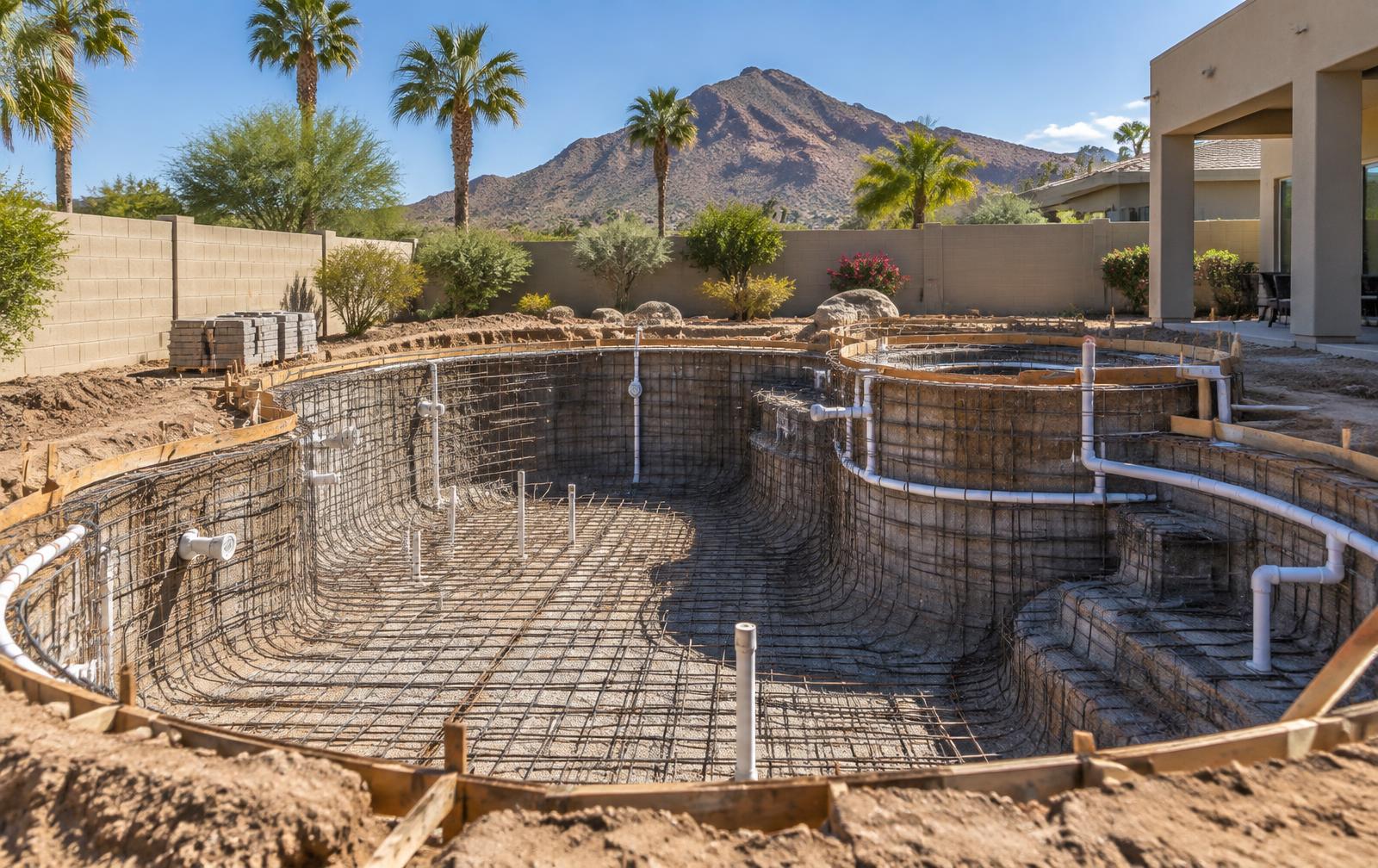
Digging a pool in Arizona is rarely a simple dirt excavation. The Greater Phoenix area is notorious for caliche. Caliche is a layer of soil where gravel and sand are bound together by calcium carbonate. It is essentially natural concrete.
Excavating through thick veins of caliche requires heavy hydraulic breakers and specialized equipment. The deeper you dig, the higher the probability of hitting a dense caliche layer. Choosing a 5-foot maximum depth instead of an 8-foot maximum depth can sometimes save you from days of expensive hard-digging fees.
Furthermore, deep excavations near property walls or house foundations require specialized structural engineering. Municipalities enforce strict setback requirements. If an 8-foot excavation infringes on the load-bearing zone of a block wall, the engineering plans will require additional structural reinforcement, driving up the construction cost.
Modifying Depth During a Pool Remodel
Many homebuyers purchase older homes with existing 9-foot diving pools. The diving board is long gone, and the new owners are left with a massive body of water that is too deep for casual volleyball and too expensive to heat.
Converting a deep pool to a play pool is a standard procedure during a comprehensive pool remodel. The process involves draining the pool, chipping the existing surface, and drilling holes in the shell. We then fill the deep end with structural gravel or a concrete slurry mix, compact it, and pour a new reinforced concrete floor at the desired depth. Finally, the entire pool is replastered.
While this requires an upfront investment, it fundamentally changes how the family uses the space and immediately lowers ongoing utility and maintenance costs.
Frequently Asked Questions
What is the best depth for a family pool?
For a family pool focused on games, relaxing, and standing, a 3-5-4 foot play pool configuration is the most functional and cost-effective design.
How deep does a pool need to be to install a slide?
Most residential pool slides require a minimum water depth of 36 to 48 inches in the drop zone, depending on the specific manufacturer specifications. You do not need an 8-foot deep end for a standard water slide.
Can I add a Baja shelf to my existing pool?
Yes. Adding a Baja shelf is possible during a major remodel. We construct the new shelf inside the existing shell using structural fill and concrete, then tie it into the new interior finish.
Are 6-foot deep ends useful?
Generally, a 6-foot maximum depth is the least practical option. It is too deep for the average adult to stand in comfortably, yet too shallow to safely allow diving. It wastes water volume without providing a specific functional benefit.
Plan Your Pool Layout With Exact Specifications
Your pool should be engineered around how you live, not just how it looks on paper. Whether you need exact water depths for a swim-up bar or you want to transform an old diving pool into a modern play pool, precision matters. Contact Sun America Pools & Spas to schedule a design consultation for your Phoenix backyard.